Wednesday, August 08, 2007

The Monster

The monster comes in the night,
Unexpected and fully disguised,
Prepared to destruct and disrupt poor lives.
Without sympathy or hesitation,
With only big weapons and fear,
The monster comes in the night.

The people shocked, frightened
Crying and screaming,
Grab every belonging they can carry with their two arms, head, and back,
Grab their livestock and their children,
And head north.
Just head north unclear of a destination,
Just far away from fear, where the monster can't find them.

But the monster will find them,
All the days of their earth-life,
They will live in no home built by their-mans hands,
They will live off the fruits nature provides to them alone,
They will live in uncertainty and hardship,
Waiting for the monster to come,
In the night
This is the way it will be.

Monday, July 09, 2007

Gadaa System: A Traditional Conflict Resolution System Used in Oromia, Ethiopia

Water is so easy to take for granted. You go to the grocery store to buy drinking water, only to be confused over which of the 30 brands of water tastes the best. It's really hard to imagine someone picking up a gun to battle over water. But in Ethiopia, out of 1,119,683 sq km of land only 2,900 sq km (CIA 2003) is irrigated land. That is - if you round the way we were taught to round in elementary school math - 0% (actually 0.259%). So, most people living outside of the city (which is over 80% of the 76 million population) rely on rainfall and nearby bodies of water for drinking water, baths, washing clothes, feeding their land and animals, etc. This is a picture of a Boran woman (from the Borana zone of the Oromia State in Ethiopia). The Boran people rely on pastoralism over farming because of the ecological conditions of the area. Pastoralism (def.) is "the breeding and rearing of animals" (Geographical dictionary). "It also contains a mobile element, moving the herds in search of fresh pasture and water (Wikipedia)." So, because water and pasture is limited, especially in extreme situations (dry season/polluted water), a system of law and conflict resolution has been used for decades.

The Gadaa System divides the men in the community into 5 main age groups in which each group has a role to play in maintaining the flocks, the water, the land and the peace (there are additional groups but they play a more symbolic role:


1. FOOLLEE (ages 9-16) - duty is to look after small stock around their area.
2. QONDAALA (ages 17-24) - duty is to take livestock away from their area and begin drawing water from wells.
3. KUUSAA (ages 25-32) - duty is politically significant; nucleus of Gadaa leaders emerge.
4. RAABAA DOORII (ages 33-40) - duty is an extension of Kuusaa grade; prepare for the assumption of full authority; important military services; conducts raids; protects Boran land and resources; men allowed to marry at this stage.
5. GADAA (LUBA) (ages 41-48) - duty is most politically active; most important of all stages; assumes power/office; visit all Borana regions, judge on serious disputes; this stage is marked by a leadership ceremony.


Those over the age 48 are considered the YUBAA; they are the old, wise men who take on an advisory role. Any boy under the age of 9 has only a symbolic role as a mediator between God and humans. Then there is the ABBAA GADAA who is the one leader of Gadaa; he is like the president of Boran. He is called to judge when there is conflict between area within the Borana zone. If there is a conflict between ethnic groups, then the Abbaa Gadaa will be called to make peace.

A few Customary Laws:

1. During wet seasons, only open water sources (rivers, national ponds, ponds) are used and wells are closed.
2. During dry seasons, herds are moved to ponds farther away and traditional wells are re-opened.
3. During the really dry seasons, when water is scarce, drinking frequency of cattle is gradually reduced to once a day, then to once every two days, and then once every three days.

The men in the RAABAA DOORII age group watch to make sure these laws are upheld. The most highly protected sources of water are hand-dug shallow ponds and wells.

Customary Law - traditional management of resources - are in danger of becoming inferior and almost insignificant in many areas. Central government and development projects are using the force of power to override customary law and make their own judgments on water and land use. Sometimes even taking land and bodies of water for their own projects; thereby, decreasing resources for the inhabitants and increasing competition for the limited resources. Industry pollutes the natural bodies of water, further frustrating resources for the rural people.

What's the solution to this problem? Traditional conflict resolution systems are not sufficient alone as rural societies are no longer pure of foreign influence - government, NGO development projects, commercial production and industry. So, how do we eliminate the need of conflict and guns?

(Source: http://www.nri.org/waterlaw/AWLworkshop/DESALEGN-CE.pdf)

Friday, July 06, 2007

What Man Created in the Beginning

Urbanization, Industry, Commercial production
Created by humans
Not for humans
More suitable for robots
Hence, the sudden employment of computerized service machines in local grocery stores, robot receptionist in Japan hotels, computer software programs to do your taxes, marketing, almost anything you want

In the beginning,
I imagine,
People considering population growth, environmental conditions, competition for resources and their own want for power and greatness
Gathering and proclaiming "let's build a big city, let's build a tall building their in the center, and let's create a big market"
I wonder if they imagined the world we live in today
Big glamorous cities filled of still unsatisfied people

The capitol city of Ethiopia, Addis Ababa, is crowded of such people
Unsatisfied, misplaced, misguided, forced into urbanization
Competing for the little resource available in the city - the birr
Forced to abandon the great resource in their rural homes - their land and the fruits of their land

Human nature has brought us into war with nature
Human nature has in desire of power, glory, and wealth created an uncontrollable monster -
A market and world dependent on computers, industry, and everything not human
And now we struggle for our daily bread, and we struggle for our daily happiness
Waiting for the end
When I imagine,
We will be destroyed by our own creations.

Wednesday, July 04, 2007

Made in Ethiopia

This time the Italians didn't do it. No, we can't blame it on the government. Don't even try to put this on capitalism. It is all our fault - my fault, your fault, we all fault. Ethiopians not valuing Ethiopians, Ethiopia, and everything made in Ethiopia.

Preparing to buy furniture to match your new expensive house, you don't automatically consider furniture manufactured in Ethiopia, by Ethiopians, with Ethiopian raw materials. And why would we? We've been told that everything made in Italy is the best quality. And Ethiopia...well, Ethiopia is a third world country with third world material. And for my house, I need something durable, with a guarantee, and something with a quality finishing that screams made in Italy. This is sadly the mentality of many Ethiopians. While Ethiopian manufacturing companies struggle to compete on an unfair market with the foreign wealthy companies; we Ethiopians spend our money, time, and mouth advertising against them. The competition is clearly unfair in terms of the amount of money most foreign companies have invested in equipment, advertising, and presentation. But we individual Ethiopian consumers are making the competition even more difficult for our Ethiopian producers/brothers because of our misconception of Ethiopia's ability and worth.

It is true – the finished products of some Italian companies are more pleasing to the eye (on the surface). It is also true – that Italian companies in general are more trustworthy in terms of replacing damaged pieces and providing legitimate warranty. But it is also true that Ethiopia is a poor developing country. So, I think it is our responsibility as Ethiopians (with the money and education capacity to make conscious decisions) to sacrifice a little bit (just a little bit) to help our own companies by 1) reversing the idea (in your own mind first and then in your friend's) that foreign products are simply better than local products 2) actually go look at the local producers, the material they use, their history and fairly consider them as an equal competitor 3) don't be blindly impressed by the wonderful slide shows, advertisements, and the nice expensive shop location (Dumbel Mall) used by foreign producers – if the money is available it is easy to have these things; instead, look at the material they use, their warranty, the price, etc.

There are people trying to make Ethiopia a better place – trying to increase local economic activity. Globalization is making their efforts seem pointless. It's up to us the consumers to help them and in turn, help our country stand on its own.

Friday, June 29, 2007

Good Morning Addis!

I am finally here. Good morning Gunfo! Good morning Addis Ababa! Good morning the best tasting coffee in the world! Good morning the biggest baked bread in the world!

Ahhhhhh! I can finally exhale; and my breathe can mix with Addis Ababa's air. It was such a struggle, making the decision to move here for a personal informal education, school (MA in Ethiopian Studies at AAU) and work. The process of convincing my family and myself at times (a two year process) that the risk (of being robbed in Merkato, dying of Malaria, receiving a poor education, being arrested by the government, having my hand eaten off by a lion, etc.) was worth my time exhausted my eagerness to come. I was falling into indifference; and how dangerous is the feeling of indifference. It wasn't until my flight to Ethiopia that my spirit was renewed. I met a white American man who was on his way back to Ethiopia. He lives here and he has been living here for 10 years. Then I met some other young Americans who were traveling to a small town near Harar, Ethiopia to teach English for 6 weeks; and I felt ashamed. I was ashamed because I was so afraid of my own country, my own people; but at the same time, I was relieved because I was finally here and descending onto the ground.

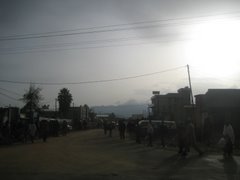
I stepped out of the airport and with every strength of my nostrils, I took in each scent, inhaling a thick perfect mixture of bad smells - car pollution, sweat, bad food, rain, sewer, and must. With every open pore on my skin, I absorbed each heavy particle from the air - dirt, pollen, carbon dioxide. The next day, I housed every image in my mind - children running eagerly alongside the car, shop owners standing still outside their shops, a group of 20 men energetically helping a man fix his just broke down car, a gush of black smoke escaping the exhaust of an ancient pick up truck, women laughing and gossiping hand in hand, the city in peace in a gray mist, about a hundred people kissing the wall and ground of a church on a Thursday afternoon, commercial billboards of beautiful girls dressed in little clothing, hungry stray dogs weakly searching for food. I stored it all in my body, mind, soul, and some on my digital camera so that you all can see! Enjoy Addis.


...more to come

Thursday, April 19, 2007

The City of Addis Ababa


Addis Ababa (translates to New Flower) is the capitol city of the third most populated country in Africa - Ethiopia. The city is blooming with new construction projects arising every day. Streets are trafficked with old Volkswagens, faded Toyota's, herds of cows and sheeps, bright blue taxi-cabs, and a few shiny black Mercedes. Buses are packed air-tight: the city's people standing shoulder-to-shoulder, drowned in each other's scent. And markets are filled with chattering shop owners eager to sell their goods. The city is the urban center of the 85% rural country.

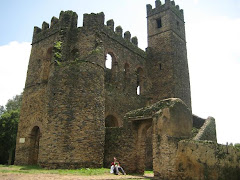
Addis Ababa was not always an urban area and moreover, it was not always the capitol city of Ethiopia. In fact, a little over one century ago, the "capitol" city was hundreds of miles north west of Addis. I put "capitol" in quotations, because in the past the capitol city did not hold as such a stable, solid political symbol as it does today. Regional governors had much political autonomy and force - most governors had armies of thousands; whereas, today the army and political power is centralized to the government in the capitol city. Back then, the political center of Ethiopia was mainly in Gondar (founded in 1636 by Fasiladas); although, at times it would temporarily relocate, reaching cities like Dabra Tabor (the center of the Yajju dynasty).

It was in the late 1800s to beginning 1900s, that the political center started its march down south. With Negus Yohannes' occupation with the Italians in the North, the Mahdist Sudanese in the West and the Egyptian/Ottomans in the East, Menilek of Shewa had the perfect opportunity to expand his influence south of the empire. So, when Yohannes died (1889) in the Battle against the Mahdist Sudanese, Menilek with few opposition rose to power.

Menilek had been expanding Ethiopia's influence to the South, which flourished with great exportable goods (i.e.coffee). So, it seemed fit to move the capitol of the empire to a new, more appropriate center. In 1881, he moved to Entotto (a little north of Addis Ababa).

Entotto had been a resting camp site for medieval kings. Menilek's palace was built here; and at times he and his wife Taytu vacationed on the southern plains were the weather was much warmer. In 1886, while Menilek was in Harar fighting the Turks, Empress Taytu migrated the royal settlement to the plains down south in what is now known as Addis Ababa. It did not officially become the capitol until 1892 with the building of the Emperor's palace, the creation of safar's around it, the building of churches (i.e. Saint George Church), and the formation of the Arada market, and finally, the completion of the French-built railway in 1917.

Today, Addis Ababa continues to modernize in the various definitions of modern -ization. Many from rural areas are moving to the urban lifestyle of Addis Ababa in primary search of economic relief. To compensate for the rapidly increasing population, the city continues to expand, with new neighborhoods, safar's, appearing more frequent than ever. Markets, malls, cafes, clubs, schools, and theaters are packed every day. And museums filled with precious artifacts and paintings of Emperor Menilek and Empress Taytu protect the history of the city and country.

Source: Bahru Zewde, A History of Moder Ethiopia 1855-1974. Addis Ababa University Press, Ohio University Press, James Curry. 1991